Why We Named It Trio
By Anna Morehart Falk · Published
The first time I heard the name out loud
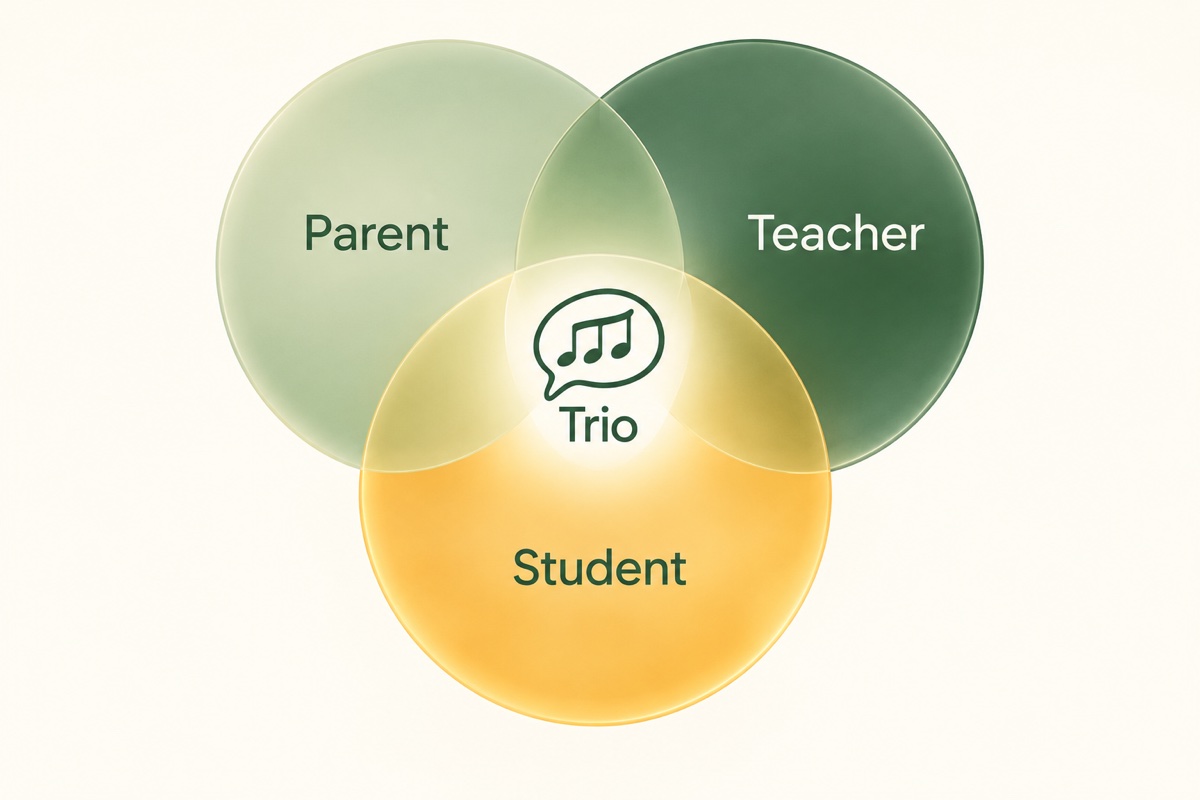
I have been a Suzuki teacher for 23 years. A large part of the Suzuki method is the partnership between teacher, parent and student, which the method of Dr. Shinichi Suzuki calls the Triangle. What does that have to do with studio management software?
My husband Justin and I built this product together. He is the tech enthusiast and I am the musician. He started the project with a working name that made sense to him, because he needed to call it something. I understood what that name was trying to do, but I never connected with it in a personal way.
We knew what the platform needed to do. It would bring scheduling, communication and billing into one easy hub, and the parent, teacher and student would each use it in the way that fits their side of the partnership. The idea of three kept coming back to me, so I knew the name had to carry it.
One night Justin typed away on his keyboard while I combed through name ideas. Made-up words. Combined words. Words with Latin roots. Names that were poetic and names that were techie. Over time we went through hundreds of them, all trying to capture the relationship between parent, student and teacher. None of them felt clear or concise.
Then I realized why. Every option was too complicated. They were working too hard and trying too hard to be clever, and that was exactly what I wanted to avoid. This app was supposed to simplify my work, not add to it. The name should reflect music, simplicity and the essence of three.
There was no lightning bolt. The realization came slowly. Justin was the one who finally said, "What about just Trio?" I tried it on for size and said, "Yes. I think that fits. That's the one." Once we had it, we both knew it was right.
The idea behind the name
The Triangle is Dr. Suzuki's idea, and the credit for it belongs to him. Most people outside the Suzuki world know the method by reputation: tiny children playing in big groups, Twinkle Twinkle as a starting point, a lot of listening, and playing by ear. The Triangle gets less attention unless you have seen the commitment underneath all of it.
In Suzuki teaching, three people work together for the good of the child: the parent, the teacher and the child. The parent is not a chaperone. The parent attends the lesson, takes notes, and becomes the daily practice partner at home. The teacher sets direction and corrects technique. The child is the musician. Each corner has a job, and none of them is optional.
Dr. Suzuki observed that children learn their native language, their mother tongue, by hearing it constantly, repeating it, and having a parent right there with them. He applied the same logic to learning an instrument. That puts the parent inside the learning loop.
If you want the full pedagogy, I wrote about it in The Suzuki Triangle: Parent, Teacher, Student. To learn more about the method itself, the Suzuki Association of the Americas is a good place to start. Here the point is narrower. In my studio the parent is a full member of the lesson. The parent's job is practice partner, not payer or chauffeur.
A trio is three musicians playing one piece together, each with a real line of their own. That is the picture we wanted for the product.
Three users, not one
Most music studio software treats the teacher as the user, the parent as a billing contact, and the student as a record in a database. That makes sense if the teacher is the customer and everyone else is a downstream result of the teacher's account.
Trio starts from a different assumption: the parent and the student need real surfaces of their own.
The parent gets a portal built for them. They can see the schedule, message the teacher, pay the invoice and read the assignment from the lesson. For younger students, the portal supports the partnership with an interactive practice tracker. Parents tell the teacher how long the student practiced, what they worked on, what went well and what was a struggle. Students encourage their parents to log practice so they can earn a prize from their teacher when they reach their goals.
Once a student is 13, they get a surface of their own too: lesson notes they can re-read, and practice assignments that show up on their own device instead of being passed along by a parent.
That is what the name commits the product to. Three first-class users, not one user and two afterthoughts. Every feature has to answer what it looks like from each of the three corners, not only what the teacher sees.
It is a harder product to build this way. I have watched Justin choose the harder path more than once, building the parent side or the student side properly when skipping it would have been faster. The name helps. It is difficult to call something Trio and then build it for only one of the three.
The studio app most people expect, and the one we built
When teachers hear "music studio management software," they expect a particular product: a calendar that handles recurring lessons, invoicing that bills monthly, and a messaging inbox so parents stop texting at 9pm. Those are table stakes, and Trio handles them.
What teachers do not always expect is software that takes a position on how studio communication should work.
Trio assumes the parent of a young student is the person you need to coordinate with, because the parent runs the practice schedule at home. It treats lesson notes as something the parent and the older student can see, not a private file the teacher keeps, because what we worked on in the lesson is what they need to work on this week. And when a parent says "I did not see that message," Trio treats that as the software's problem to solve. The teacher should not have to resend it.
None of that is exotic. It is what Suzuki pedagogy has been saying for decades. It just has not been what studio software said.
If you are a teacher reading this
If you have taught long enough, you know the difference between a parent who is in the lesson and a parent who is in the parking lot. Both pay tuition. Both put a child in front of you on Tuesday at 4pm. Only one of them knows what was assigned this week.
So Trio starts from the parent being your partner, not your customer. That is the claim the rest of the product rests on. The parent portal, the practice notes and the way messaging works all follow from it.
Treating the parent as only a billing contact is a pedagogy decision in disguise, and it works against you the moment a student is younger than 12. For young beginners, the partnership between teacher, parent and student is not optional. The software has to assume that, or the software is in the way.
Years ago I wrote a line in the welcome materials I send to new families at my studio:
"Through listening, repetition, small steps and review each one of you will create, enhance and beautify your violin skills and in so doing brighten the world."
I did not know then that it would end up in the story of a software product, but it fits. The relationship between teacher, parent and student is how we brighten the world together. The product is scaffolding that makes that partnership easier to run.
The team behind the name
Justin is my husband and the product owner of Trio. He has watched me teach for nearly two decades. He has sat through plenty of Suzuki parent training and practice charts, and he has seen how many teaching moments depend on the parent being in the room and taking notes. His awareness of my admin work started the product. From there the name grew out of my deep sense that it needed to carry the essence of three.
I am the bylined author here because the pedagogy and the lived experience are mine. The naming itself was a partnership, the way the Triangle is. That feels right for a product called Trio.
If you want to see how it works for your own studio, take a look at Trio's pricing.
Anna Morehart Falk is a Suzuki-method violin teacher with 23 years of experience and a studio of 25 students aged 3 to 18 in South Tampa, FL. She is trained and registered in Suzuki books 1 through 7 and Suzuki in the Schools levels 1 and 2. Read more about Anna.